
What Happened at Grand Central, and What the Public Was Never Taught
A machete attack on one of the world's busiest subway platforms exposed the gap between calling for help and knowing what to do before it comes.
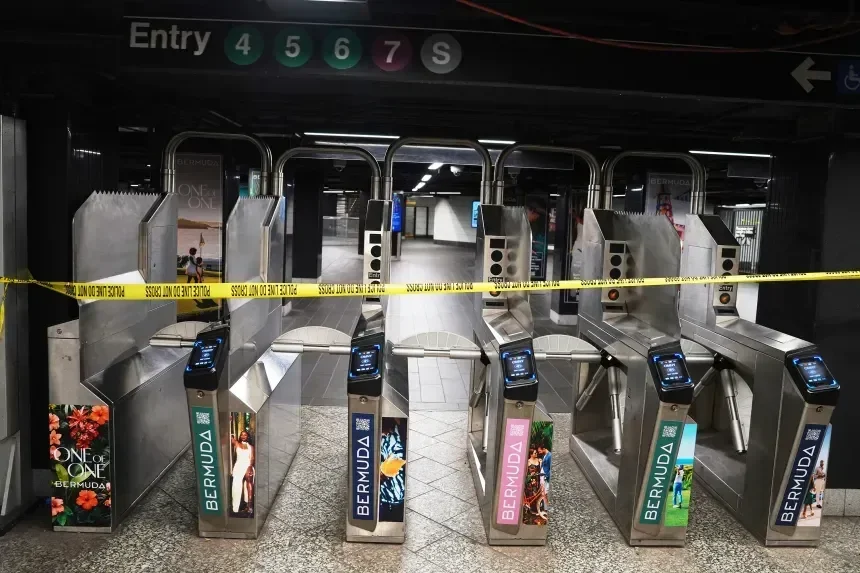
Police crime tape is placed at the subway turnstile after a reported stabbing and shooting at the Grand Central subway station in New York on Saturday, April 11, 2026. (Ryan Murphy/AP)
At 9:30 a.m. on Saturday, April 11, a man named Anthony Griffin boarded a northbound 7 train at Vernon Boulevard in Queens. He rode it into Manhattan without incident. When the doors opened at Grand Central–42nd Street, he stepped onto the platform and attacked an 84-year-old man with a machete, opening severe lacerations across his head and face.
Then he walked upstairs.
On the 4/5/6 platform, he slashed a 65-year-old man, who also suffered an open skull fracture, and a 70-year-old woman in the shoulder. Three strangers, chosen at random, on one of the most surveilled transit platforms in the Western Hemisphere.
Around 9:40 a.m., a bystander flagged down two NYPD detectives working an overtime transit detail. They found one of the victims coming up the stairs, and found Griffin on the lower platform. He was shouting that he was Lucifer. He refused more than 20 commands to drop the weapon and advanced toward the officers. One of them fired twice. Griffin was pronounced dead at Bellevue Hospital. The three victims, all hospitalized with serious injuries, were expected to survive.
The NYPD’s response was, by most reasonable assessments, swift and decisive. Between Griffin’s first attack on the 7 platform and the moment a bystander flagged those detectives however, at least ten minutes elapsed. Witnesses reported a surge of people rushing through turnstiles in blind panic. The station was shut down and the 4, 5, 6, and 7 lines were all rerouted.
In those ten minutes, three people bled on a subway platform, and everyone nearby either ran, froze, or didn’t know what to do next.
Here’s Our Timeline
Reconstructing the sequence from NYPD Commissioner Jessica Tisch's press conference and reporting from CBS News, NBC News, and Gothamist:
9:30 AM
Griffin boards the 7 train at Vernon Blvd in Queens. No reported pre-incident contact with any victims or bystanders.
9:35 AM
Train arrives at Grand Central. Griffin slashes the 84-year-old victim on the 7-platform and moves upstairs, a transition most bystanders likely didn’t register as connected incidents.
9:38–9:40 AM
Griffin attacks two more victims on the 4/5/6 platform. A bystander spots the situation and approaches two NYPD detectives on the floor above.
9:40 AM
Detectives receive the alert, move toward the platform, encounter the first victim on the stairs, then locate Griffin. Standoff begins.
9:50 AM
After 20+ commands to drop the weapon, one detective fires. Griffin is transported to Bellevue and pronounced dead.
The bystander who flagged the detectives is the uncelebrated figure in this story. No uniform, no protocol and no radio on hand. Just a decision to act and the spatial awareness to know there were responders nearby. That person may have ended the attack before a fourth or fifth victim was reached.
The Freeze Is Real, And It’s Not Weakness
In the aftermath of incidents like this, there’s a familiar frustration: why didn’t anyone do something sooner? The answer isn’t cowardice. It’s psychology.
Research going back to Darley and Latané’s 1968 bystander experiments, and confirmed many times since, shows that the presence of other people actively reduces individual action. When everyone around you is still, your brain reads that stillness as a signal: “Maybe this isn’t as serious as it looks.” “Maybe someone else already called.” “Maybe I’m misreading the situation.” This isn’t a personal character flaw. It’s a deeply wired response to social ambiguity.
1 in 3 people help during public emergencies when others are present
85% of bystander interventions against active shooters were successful or partly successful
4 min: typical EMS response time to a subway platform, significantly longer in deep-station incidents
There’s also something specific to subway environments that compounds the problem. Platforms are loud, and violence and machinery can sound similar. A sudden crowd surge reads as “train arriving” before it reads as “someone is hurt.” The underground geography, platforms separated by multiple stairwells, no line of sight between levels, means an attack on one platform is essentially invisible from another.
What breaks the freeze is familiarity. People who have mentally rehearsed a scenario, even once, respond faster and more effectively than those encountering it cold. This is what training actually does, not turn bystanders into security personnel, but eliminate the decision paralysis that costs those first critical minutes.
Three Things That Could Have Changed Outcomes
Looking at the Grand Central attack specifically, there are three distinct windows where a trained bystander could have meaningfully altered what happened before, during, and after the violence.
Before the first strike: Pre-Incident Indicators
Griffin entered the subway at Vernon Boulevard and rode to Grand Central without concealing his behavior. Commissioner Tisch confirmed he was “behaving erratically” before the first attack. Behavioral anomalies, pacing, verbal outbursts, rigid posture, scanning, are observable before a weapon is ever raised. A commuter who recognizes these as potential pre-attack indicators and alerts station staff or transit police has an opportunity to summon help before the first victim is harmed. The NYPD now has a “See Something, Say Something line”, but most people don’t know the behavioral markers that make “saying something” meaningful rather than noise.
During the crowd surge: Moving With Intent
Witnesses described a "wall of people" sprinting blindly through turnstiles. This kind of uncoordinated crowd surge creates secondary injury risk: trampling, falls and compression. It also blocks the natural path of both first responders moving in and victims needing to move out. The detectives in this case had to push through panicked commuters to reach the scene. In a compressed underground space, the difference between orderly egress and a stampede can be seconds. Individuals who know how to read crowd dynamics, pick deliberate exit routes, and avoid becoming part of the wave can protect themselves and, critically, keep corridors clear for responders.
After the attack: Injury Care
The 65-year-old victim on the platform sustained an open skull fracture and severe lacerations, while the 84-year-old had deep facial wounds. EMS response to deep subway platforms, by nature, multi-flight descents below street level, takes longer than street-level incidents. A person with basic trauma care knowledge and the presence of mind to apply direct pressure or improvise wound management in those minutes isn't playing doctor. They're keeping blood volume in a human body. Learning the foundation of trauma care can help the everyday individual keep someone alive while responders make their way.
What The Official Response Can’t Fix
In the hours after the attack, the official response followed a familiar script. Commissioner Tisch credited the officers for their decisive action and pointed to expanded transit patrols. Mayor Mamdani called for more clinicians and psychologists to be deployed underground to help commuters process the trauma. Governor Hochul praised the officers and pledged that New Yorkers would feel safe on the platforms.
All of it was reasonable, but none of it addresses the ten minutes before the radio call.
"Random acts of violence scare everyone. That is why it is so important for New Yorkers to understand that the NYPD has recently upped our presence in the transit system." - Commissioner Jessica Tisch, April 11, 2026
Griffin boarded in Queens, rode multiple stops, attacked three people across two separate platforms, and was only located because a bystander physically walked up to two detectives and told them. The officers were already there. The problem wasn’t the number of uniforms in Grand Central, it was the ten-minute window in which those uniforms had no idea what was happening one level below them.
Calling for more responders is the policy equivalent of treating a wound after it’s already open. It assumes the critical variable is response time, but response time only starts when someone triggers a response. In this case, the trigger came from a bystander who made a decision to act rather than run.
Mayor Mamdani’s call for trauma clinicians is fair as an after-care measure, but it also illustrates exactly where the official framework is focused: on what happens after people have already been hurt. There is no equivalent institutional push for what happens in the first ninety seconds, when the attacker is still moving and three people are bleeding and the platform is in chaos. That space is left entirely to chance, to whoever happens to be standing nearby and happens to know what to do.
What Training Looks Like In Practice
The bystander who flagged the detectives didn’t tackle anyone or intervene physically. They just had enough situational awareness to understand what they were seeing, enough calm to act on it, and enough presence of mind to know where the officers were. That’s a start.
Here’s the specific skills that would have been useful on April 11:
Before you get on the train
Note where the exits are. On platforms with multiple levels, take ten seconds to identify the stairs.Pre-incident behavior is visible
Verbal outbursts, fixated staring, deliberate physical positioning against others, pacing with rigid body posture, these are observable. If something reads as off, trust that read. Move away. Alert staff if you can do it safely.In a surge, slow down before you speed up
A crowd panic moves fastest toward its first instinct. Take one second to look for a secondary exit or a wall to move against. Moving slightly counter to a rush is often faster than joining it. Slow is smooth, and smooth is fast.If someone is bleeding
Direct pressure is almost always the right first move. Use whatever’s available, a jacket, a scarf, a bare hand. Press hard and don’t let go. Keep talking to the person.When you call 911
Give clear, simple details. Where is this happening, What are they wearing, What are they doing, How many people involved. Not just “there’s a fight.” Dispatch needs a weapon, a platform, and a count. Specificity routes the right response faster.
Three people left Grand Central on stretchers that Saturday morning. They were not security staff or anyone who signed up for risk. They were commuters on a weekend. The system that’s supposed to protect them responded well, but it responded to something that had already happened. The gap between the first incident and the first call is where the real work is.
That gap is where CitySafe lives.
About Us
CitySafe is dedicated to training everyday people to build safer communities. We bridge the gap between panic and effective action by providing practical, high-impact training to agencies, organizations & communities in major metropolitan areas.
Ready to level up your preparedness?
Visit our website to learn more about our services and book a free discovery call with our team.
